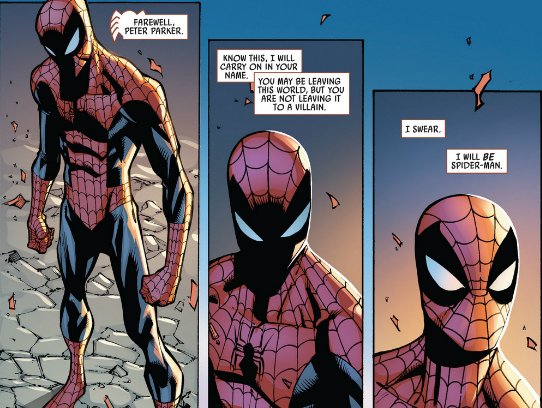
Peter Parker was my hero. I wish I could say that he was taken before his time, but as he is a fictional character, time becomes a relative thing. What I can say is that he will be missed.
Peter Parker may have been Spider-Man, but it was the man, not the costume, that inspired me.
First off, though I know it is extremely unlikely for him to read this, I have a few choice words for Dan Slott, the current writer of the series. No one else needs to pay attention to this:
Dear Mr. Slott,
How. Dare. You.
Who do you think you are? How could you do this? What gives you the right? Do you even know what you've done, Mr. Slott?
Do you even know?
I grieve the death of Peter Parker (I'm in the anger stage specifically), but one of the things that Peter taught me is that you cannot let feelings rule your life, and you need to overcome them eventually, as he did with the black symbiote that eventually became Venom. Peter was a hero who fought and triumphed over more than one type of enemy. His heart was always greater than his Spider-Sense.
Though I am not worried about the Marvel Universe; true to his character, Peter Parker kept it safe in his final hours. Peter Parker may be dead and Doctor Otto Octavius (more commonly known as Doc Ock) may now driving Spider-Man's body, but Otto is an ex-villain because Peter, through his last actions, showed Doc the truth behind Spider-Man. Otto may have gotten the power that he's always wanted, but Peter ensured that Otto would use this power well. Peter saved a villain from villainy.
I've tried to understand Slott's reasoning behind this move and I've read a few interviews. Though I find some of them to be in bad taste ("Dra. Ma." I mean seriously, you're killing off someone else's creation who has inspired multiple generations. The least you could do is have some tact about it) and others I find to be facile justifications, on the whole, I do not blame him. Heroes die, and the test of their merit is their legacy.
Peter learned to be a hero the hard way; his beloved Uncle Ben died, God rest his soul, because Peter refused to prevent a crime. Peter took responsibility for his Uncle's death, a reaction not common in this day and age. Most of us would have told him not to be hard on himself; there was no way he could have known what was going to happen to his Uncle. He was not responsible for the crime, so what if he had the power to stop it.
In this day, we are quick to seize power and have a great desire to use it, but it takes a special kind of person to move past their selfish desires and ask what it means to use power well. We crave money, knowledge, influence, strength, authority, yet we never ask what it means to be responsible with these things. Some, like myself, crave these things in the hopes that, through them, we can ignore our responsibilities.
Peter did not stop the crime that ended up killing his Uncle, but was it his responsibility to do so? Does he have to be responsible simply because he has power?
If you don't know the answer to that, you must not have known Peter Parker very well.
Peter wasn't the one who killed his Uncle; that guilt rests on someone else. Yet Peter could have stopped his Uncle's death. What if it wasn't his Uncle that was killed, but just some random person? Would that have changed the situation? To the policeman, the doctor, the emergency worker, the soldier, and all the heroes of everyday life, every person is just some random person, but this random person is somebody to someone.
Peter Parker forced me to ask this: Can I ignore evil so long as I am not the one doing it?
Edmund Burke said "All that is necessary for the triumph of evil is that good men do nothing." In Genesis, it reads that "If you do well, will you not be accepted? And if you do not do well, sin is crouching at the door. Its desire is for you, but you must rule over it.” Peter understood this.
A sin of omission.
Passivity in the fight between good and evil is impossible. Peter showed me that even if evil is not triumphing over me, if I do nothing, then I let evil triumph in someone else's life. The bad guys win. I may not have caused it, but I allow it. And what does that say about me, if I can look at something terrible happening yet do nothing?
Peter Parker fought for as many people as he could as often as he could. He would never turn down a cry for help, even from a villain. He never stopped fighting the good fight, and he made the world a better place. It's not that he wasn't tempted to stop, but, in the end, he'd always be back to finish what was started.
Some people would say that no comic book hero ever really dies. They resurrected Superman, healed Batman's broken spine, and returned Captain America from the grave, but who is to say that Peter Parker will not remain dead? Let us not be in denial; this could be permanent. I'll never be trite about the death of a hero.
Otto Octavius may have to live with the permanence that he killed Peter Parker (that goes double for Dan Slott). He'll need to struggle with the dilemma that he is living a lie; by keeping his identity a secret, he lets Peter Parker's killer roam free. I sincerely believe that Otto has the opportunity to change, but I wonder if he will be content to live this lie. If he is the hero that Peter Parker was, he'll need to struggle with this. I don't know how this will play out.
But that is besides the point.
The point is that Peter Parker died how he lived. He was a hero, through and through. He fought for us, and, more importantly, got us to fight with ourselves. He made us look inward and challenged all of us to be heroes ourselves: you, me, even Doctor Otto Octavius.
I said earlier that a hero's merit is tested by his legacy. Like Uncle Ben, Peter Parker left us with a simple phrase that is the essence of real heroism. Do I even need to say it? Dare I say it? Of course I dare to say it, but Peter dared to live it.
"With great power comes great responsibility."