So, unfortunately, I seem to have missed my chance for providing
a hard-hitting commentary on the Man
of Steel movie due to a
desire of wanting to avoid spoilers.
Whoops.
However, because I am such a devotee of Superman, talking about
it (and having an opinion on it) is inevitable.
Fair warning: as much as I wanted to avoid it, this does contain
spoilers for Man of Steel.
If you want to avoid them, stop reading now.
Let’s get the obvious out of the way first. For those who have
not read the aforementioned hard-hitting commentaries, a notable critique of Man of Steel is the widespread destruction in
Metropolis and Smallville. Hundreds, maybe thousands, of lives are lives are
lost in the war between Zod and Superman, yet this Man of Steel seems to care
very little about the lives he is ruining.
Zod may have made it a mission to destroy humans, but the Man of
Steel also spread a fair share of misery. And he didn’t seem too heartbroken
about it; at least he’s not sad enough to not make out with Lois Lane in the
ruins of Metropolis.
Ahhh, destruction. The most sublime of aphrodisiacs.
But let’s be fair: this is a younger, inexperienced Superman
wrestling with his identity and forced to fight Zod, the perfect soldier with
all of Superman’s alien powers.
The Man of Steel triumphs over his adversary and makes a tough
choice while doing it; he takes the hard line and makes a decision, and, in
this choice, he manages to save one without (completely) destroying the other.
It’s hard to call him anything but a hero.
As Pa Kent puts it, Superman is, and will always be, an
inspiring figure, but it is up to him as to if it will be for good or for evil.
And this is the part that I want to focus on.
Anyone with power will be an example. It cannot be helped. By
his very nature, Superman is inspirational; humanity will always look up to a
man who can fly.

The Man of Steel does something good and is, ultimately, a good
role model. My largest problem with this is that Superman was never meant to be
just a “good” role model.
An inspirational figure (both good and bad) contains a paradox;
they are sacrificial yet invincible. They give up something to help the world,
yet do it without compromising themselves. Superman defeats Zod and makes the
tough decision. However, at no point did I feel like Superman was this unbeatable-yet-tragic
force that he has forever been.
Superman’s largest criticism of “I just feel like there was no
way for him to lose” is, ironically, the whole point of Superman. That is who
he is meant to be: humanity’s champion.
Sure, the Man of Steel saved the world, but he had to kill Zod
to do it. Sure, the Man of Steel saved people’s lives, but there was no rousing
speech about how all life is sacred or that even a gentle rebuke of Zod saying
that he was wrong in what he aimed to do.
He didn’t even go out of his way to save kittens from trees.
The Man of Steel fight with Zod is a battle between gods, and
humanity is ignored in their skirmish.
Superman is a good man in the film, but at no point do I believe
he is something more than that. I feel like I can have an attitude like the Man
of Steel, but that is not what it means to be the best. The best is so high up
that you should question if you would ever have what it takes to be that good,
even though they insist that any man can reach it.
When the best triumph, my normal response is “I feel like he
cheated.” I think most people feel this way.
Don’t believe me? Let me site another movie then: Superman.
Fair warning: as much as I wanted to avoid it, this does contain
spoilers for Superman. If
you want to avoid them, stop reading now.
In Superman, Lex Luthor has devised a series of insane
tasks in order to push Superman to his limits and, ultimately, distract him so
that Mr. Luthor could carry out his dastardly plots. Despite overwhelming odds,
Superman manages to stop missiles from wiping out cities while preventing
earthquakes while completely saving every life in the process….except for
the one person who he cares about the most: Lois Lane.
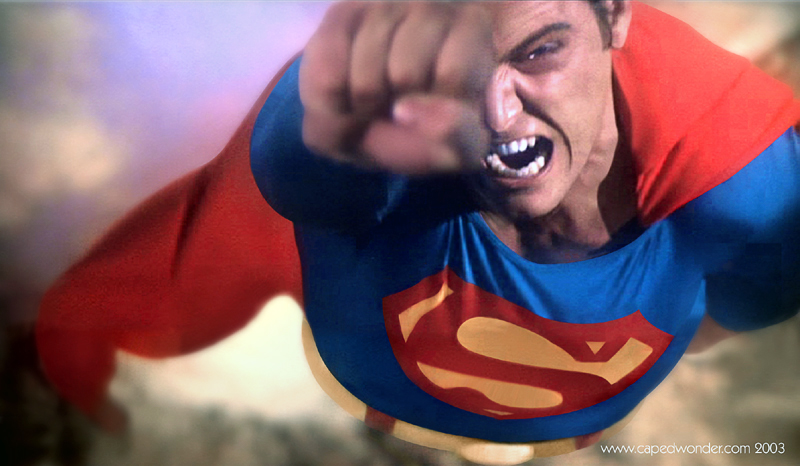
Grief ridden, Superman flies into the stratosphere and soars
around the Earth at such an intense speed that he reverses the rotations and
turns back time and then arrests Luthor before he has the opportunity to put
his plan into motion.
What a great ending! Makes me all fuzzy. Seems like he cheated.
What a great ending! Makes me all fuzzy. Seems like he cheated.
Regardless of how campy the plot is (not to mention the tears
that scientific minds must have shed at how time is reversed), Superman
had an inspirational ending. Not only did Superman have to endure his ultimate
pain, he quickly mastered it and overcame it in such a way that everyone could
be saved.
The loss of even one life was unacceptable.
A horrible sacrifice followed by an ultimate victory. At no
point could Lex have ever defeated Superman, yet no pain could have been worse
for Superman than what he had to endure.
I like it when the good guys are unbeatable. It makes me feel
safe. It makes me want to be good. It makes me confident that good will win in
the end, because evil never had any real power over it.
Still, perhaps defying the rules of space and time makes
Superman look like too much of a cheater. Let’s try a different series: Avatar
the Last Airbender.
Fair warning: as much as I wanted to avoid it, this does contain
spoilers for Avatar the Last
Airbender. If you want to avoid them, stop reading now.
The world of Avatar is driven by the 4 elements (fire,
water, earth, air) and people’s ability to magically manipulate them (called
bending). The title character, the avatar, is the only person who is able to
“bend” all 4 elements; all other characters can only use, at most, one element.
In a world based on the elements, the avatar is a naturally inspirational
character: he physically embodies an ideal of balance and harmony.
The whole world will look to him, and he will either be a force
for good or a force for evil.

In the series finale, Aang, the current avatar, faces a dilemma.
In order to restore balance to the world, Aang must battle the Firelord.
This can only end one way: either Aang dies or the Firelord
does.
We all know that the Firelord will try to kill him, but Aang is
a peace-loving soul who believes that all life, even the Firelord’s, is sacred.
This internal dilemma weighs heavily on the 12 year old boy and, as he goes on his
spiritual quest toward enlightenment, everyone seems to be telling him that
death is the only answer.
Of course, Aang manages to find a way around it. A thought-to-be-extinct
Lion-Turtle teaches him a new kind of bending that allows him to disable the
Firelord and take away his fire bending.
I don’t know if we can imagine what it would be like for a 12
year old to contemplate murder; it’s a burden I hope no young person can
readily relate to. But Aang shoulders it.
No, that’s an understatement. Aang beats it.
Aang defeats evil without using the tools of evil. He shows that
harmony between the elements can be achieved while keeping life sacred. In
fact, an unheard of bending was discovered just because Aang hung fast to his
convictions and refused to toe the line. He refused to even flirt with it.
Seems like cheating.
The world is a hard place, and hard decisions need to be made. That’s
harsh of me though…and very
pessimistic. I should be happy that a 12 year old did not have to resort to
murder, and that peace could be won without lives being lost.
But I guess you can say that this was a kids’ show and, of
course, the writers did not want to show anyone dying. Kids should believe that
good guys win, even if the world isn’t like that. Well, I have one more example
to point to: Christ (since Man of Steel was sooo keen on using Christ
imagery).
Fair warning: as much as I wanted to avoid it, this does contain
spoilers for the Bible. If
you want to avoid them, stop reading now.
Admittedly, this section is only a very brief part of my
beliefs, but I think it’ll suffice to cover my points on inspiration.
I’ve never had a problem with believing that Christ’s death and
resurrection happened; my stumbling block was believing that God wasn’t
cheating.
How is Christ’s death a hard thing if He knows He’s going to
come back from the dead? Would God really send his Son into Hell? Did God
really forsake His Son because He bore my own mistakes? And how does this
somehow mean that I can go to Heaven? Evil still flirts with me shamelessly,
how can another person’s death do anything to help me?
Surely, I just need to stop taking charity, man up, and do it
myself.
Accepting forgiveness over me having done nothing seems….empty.
It seems like it is too easy. It seems like the world should work in a
different way. It feels like cheating.
But, in a way, it is those same reservations that let me be
inspired by it. Through seeing death as something tragic-yet-unbeatable, as
horrible-yet-redemptive, as sacrificial-yet-loving, I’m inspired.
I don’t have to understand a hero to recognize them as heroic.
In fact, when I don’t understand them, I aspire to be something different. I
want to become like them. I want to be something more.
Unbeatable figures give me something to aspire to. They show me
that there is something unbreakable out there. They give me hope.
Let’s go back to Superman and the Man of Steel.
A Man of Steel may have been willing to dive into the muck to
help the world, but he didn’t inspire me to rise above it. Superman does
though. You can kill his beloved, tempt him to take the easy way, or even kill
him, and he will still win. When he dives into the muck, he comes out of it
spotless, becoming the model which people can aim for.
The Man of Steel is a good man,
but Superman is something more. The Man of Steel does what is “good enough”, but
Superman pushes people beyond that. He raises the bar and, by his example,
insists that we all do the same.
It might suffice to say this: the Man of Steel makes me feel
good about the choices I’ve made, but Superman makes me want to be better. He
makes me want to be a, well, super man.
